Discover more from Dr. Staci on Substack.
Fix cavities, bad breath, receding gums, snoring, and hormones at the root. Weekly at-home tips from a board-certified dentist, because “brush, floss, and avoid sugar” were never the only answers. 🦷


Neither is either. Both are remineralizing agents with good evidence behind them, and they work by different mechanisms. My first pick for most mouths is hydroxyapatite, and I keep fluoride on the shelf for specific high-risk situations.
I’m not anti-fluoride, and this should be your call. Let me walk you through how each one works, so you can make it.
Fluoride makes the outer surface of your enamel harder to dissolve during the next acid attack. It works topically, right on the tooth.
Your enamel is about 97 percent hydroxyapatite, a calcium phosphate crystal, and it starts dissolving when the pH in your mouth drops below roughly 5.5. Fluoride grabs calcium and phosphate from your saliva and builds them back into the enamel surface as fluorapatite. That slightly different crystal holds out until the pH falls closer to 4.5.
Two details matter here. The effect is concentrated at the surface, and it depends on your saliva having enough calcium and phosphate on hand to work with. Fluoride is still considered the gold standard in dentistry, and for good reason: on the tooth, it works.
Swallowing is where my concern lives. Fluoride is great on teeth and less great in the body.
That is why toothpaste tubes carry a poison control warning, and why children who eat their toothpaste can end up with fluorosis.
Two big reports from 2024 are worth knowing. The National Toxicology Program concluded with moderate confidence that fluoride exposures above 1.5 milligrams per liter in water are associated with lower IQ in children. A Cochrane review the same year found that the benefit of community water fluoridation has shrunk since fluoride toothpaste became universal.
To me, that makes water fluoridation look outdated and worth studying much more deeply, especially given how many sources of fluoride we stack up over a day. Topical use is a separate question from swallowed exposure, and I keep those two apart. I have no quarrel with fluoride on teeth. My quarrel is with swallowing it, and I want you to be the one choosing.
The best current trials say yes, about equally well for preventing cavities.
Hydroxyapatite toothpaste puts the tooth’s own mineral back where it came from. Nano-sized particles of calcium phosphate bind to the enamel, fill microscopic defects and act as a reservoir of calcium and phosphate that saliva can draw on.
Because it is the same material as the tooth, it can penetrate deeper into an early lesion and keep working below the surface. It also brings its own building blocks, so it doesn’t depend on your saliva supplying them.
Japan has used it in toothpaste since the 1980s. And it is safe to swallow, which matters a lot for toddlers and for anyone else who can’t spit reliably.
The evidence has caught up in the last decade, and it now comes from randomized trials in three very different groups:
Multiple randomized trials now point in the same direction, which is about as good as toothpaste science gets.
For most people, I recommend a nano hydroxyapatite toothpaste as the daily driver. Boka, RiseWell and NOBS tablets are the ones in my own bathroom.
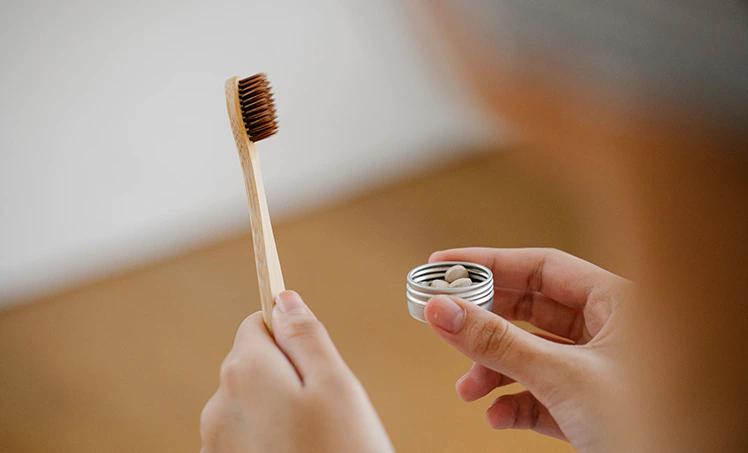
NOBS (short for No Bad Stuff) deserves a closer look, because it is a tablet: you chew one, then brush. It is fluoride-free, uses 5 percent nano-hydroxyapatite, comes without plastic packaging and lives in my travel bag, since tablets don’t count toward the airport liquids limit. In a 2025 lab study run with the University of Texas Department of Comprehensive Dentistry and published in MDPI’s Dentistry Journal, the tablets were as effective as a 1,100 ppm fluoride toothpaste at preventing enamel demineralization. Two honest footnotes: it was done on enamel in a lab, and the brand partnered on it. I still like it a lot.
If you want fluoride-free without hydroxyapatite, Theodent is my other favorite. It is built around Rennou, the company’s name for theobromine, a compound from cocoa, and Theodent Kids is chocolate-flavored and labeled safe if accidentally swallowed. Most of the theobromine evidence so far is lab work and small studies, so I call it promising rather than proven.
Fluoride has a well-earned place if you have a history of frequent cavities, dry mouth from medication, active white spot lesions or braces. A prescription-strength paste or an in-office varnish can make real sense for you. The deal is that you spit it out, and children should be old enough to do that reliably.
Some high-risk patients alternate, with hydroxyapatite in the morning and fluoride at night. That is a reasonable way to get both mechanisms working for you.
Both agents rebuild mineral. Neither one stops you from losing it.
If you sip kombucha across the afternoon, snack every ninety minutes or sleep with your mouth open so your saliva dries up overnight, you are dissolving enamel faster than any paste can replace it.
I see a version of this every few weeks. A woman in her 40s, the healthiest eater I know, sits down with four new cavities and a very good hydroxyapatite paste in her bag. “I switched toothpastes and it got worse.” Then we walk through her day, and there it is: one bottle of ginger kombucha, sipped slowly from 1 p.m. to 5, every single afternoon. Her paste was fine. Her teeth were sitting in acid for four hours a day.
Toothpaste is maybe a tenth of the cavity equation. The rest is how often acid hits your teeth and how much saliva is around to rescue them.
This is my bigger critique of my own profession. We tend to reach for a fluoride fix and skip the root causes: saliva, an imbalanced oral microbiome, ultra-processed food, eating frequency, mouth breathing, gut health and mineral or vitamin gaps. The paste matters. The habits around it matter more.
Hydroxyapatite vs fluoride is a closer contest than either camp admits. Fluoride hardens the surface into a more acid-resistant crystal. Hydroxyapatite replaces lost mineral with the same mineral teeth are made of, and it is safe to swallow. Randomized trials show them performing about equally for cavity prevention. I reach for hydroxyapatite first, keep fluoride for high-risk mouths that can spit, and let the patient make the call.
Can I use hydroxyapatite and fluoride toothpaste together? Yes. Some of my high-risk patients alternate, using hydroxyapatite in the morning and fluoride at night, which puts both mechanisms to work. Just make sure you spit the fluoride paste out. If you aren’t at high risk for cavities, a hydroxyapatite paste on its own is a solid daily choice.
Is hydroxyapatite toothpaste safe to swallow? Yes. Hydroxyapatite is the same calcium phosphate mineral your enamel and bones are made of, and Japan has used it in toothpaste since the 1980s. That makes it a good fit for toddlers and anyone who can’t spit reliably. You still don’t need to eat it, but an accidental swallow is no cause for alarm.
Why do most dentists still recommend fluoride? Fluoride has decades of research behind it and works well topically, so it remains the gold standard in dental training. The hydroxyapatite trials are newer and growing fast. Many dentists are still catching up on them. If you prefer hydroxyapatite, it is a fair conversation to have with yours.
What should I look for in a hydroxyapatite toothpaste? Look for nano-hydroxyapatite listed as an active or key ingredient; the 2019 children’s trial used a 10 percent concentration. Boka, RiseWell and NOBS tablets are the ones I use. A gentle formula without harsh foaming agents is a bonus if your gums or mouth are sensitive.
Dr. Staci Whitman, DMD, FMCP, is a board-certified dentist and is certified in functional medicine. She is based in Portland, Oregon and is the author of SPIT (Crown, 2027).