Discover more from Dr. Staci on Substack.
Fix cavities, bad breath, receding gums, snoring, and hormones at the root. Weekly at-home tips from a board-certified dentist, because “brush, floss, and avoid sugar” were never the only answers. 🦷

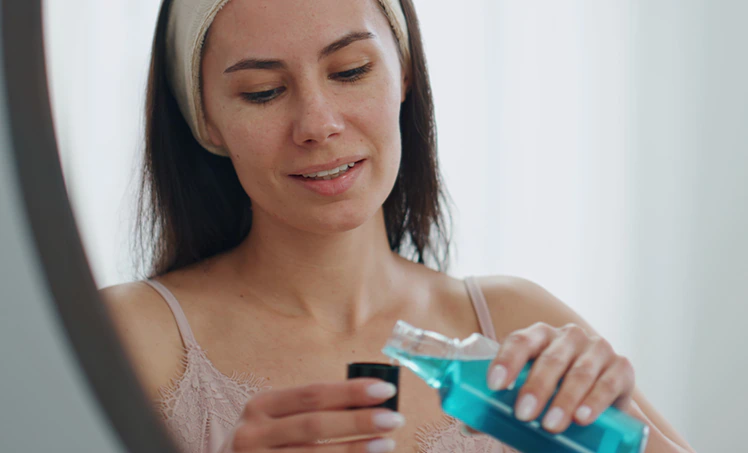

When people ask me “is mouthwash bad for you?” they usually want a yes or no. Here is mine: daily antiseptic rinsing is one of the few oral habits that can measurably affect the rest of your body.
Your mouth is an ecosystem, and most of its bacteria are on your side. A twice-daily chemical burn treats all of them the same.
It can. Antiseptic mouthwash kills the tongue bacteria your body relies on to make nitric oxide, and blood pressure has gone up within days in controlled studies.
Here’s how the pathway works, and I promise it’s one of the coolest bits of human biology. When you eat nitrate-rich vegetables like arugula, spinach and beets, the nitrate gets concentrated in your saliva. Bacteria living in the grooves of your tongue convert it to nitrite. You swallow that nitrite, and your body turns it into nitric oxide, which relaxes blood vessels, lowers blood pressure and improves blood flow.
Humans don’t have the enzyme to do that first conversion step. The bacteria do it for us, which makes your tongue a tiny, unpaid cardiology department.
Several studies, over more than a decade, line up.
Those are small numbers per person and large numbers across a population. A couple of points of systolic pressure, multiplied by everyone who rinses twice a day, adds up.
There is an association worth knowing about. In a 2017 study from the University of Puerto Rico (Joshipura), adults who used over-the-counter mouthwash twice a day or more had about a 50 percent higher risk of developing prediabetes or diabetes over three years.
That study shows a link, and it can’t prove the mouthwash caused it. But nitric oxide also helps insulin do its job, so the connection makes mechanistic sense.
Alcohol is the other issue. Classic amber Listerine is roughly 20 to 27 percent alcohol, which dries the lining of your mouth.
A dry mouth loses the saliva that buffers acid and keeps the sulfur-producing bacteria behind bad breath in check. That sets up a rebound loop: fresh breath for twenty minutes, then a drier, smellier mouth by lunch, then another rinse. It’s a subscription you never meant to sign up for.
A dad once told me, with real pride, that he kept a bottle of the amber stuff in his car. “Morning, after lunch and before every meeting.” His tongue was dry and coated, his gums were irritated, and his breath, bless him, was the reason he kept buying the bottle. We swapped the car bottle for xylitol gum and water. Three weeks later he said his wife had stopped offering him mints.
Chlorhexidine, the prescription rinse, is the strongest antiseptic in dentistry, and it comes with its own list. The recognized chlorhexidine side effects are brown staining on teeth and the tongue, altered taste that can last weeks, faster tartar buildup and, rarely, sloughing of the cheek lining.
That list is why it is meant for short courses.
There are good reasons to use one for a defined stretch.
After gum surgery or an extraction, when you can’t brush an area, a week or two of chlorhexidine keeps infection down while the tissue heals. During active periodontal treatment, a dentist may prescribe it to knock back the anaerobes under the gum.
Those are prescriptions with an end date. A lifelong twice-daily habit picked up from a commercial is a whole other animal.
For everyday use, I like rinses that support the ecosystem. Mine is about as fancy as a science fair volcano: a little baking soda stirred into water and swished hard after a meal when I can’t get to a toothbrush.
A liquid swished around the mouth won’t remove plaque from between your teeth or under the gumline, and those two places are where cavities and gum disease begin.
Mouthwash is a finishing step at best. If you are rinsing in place of flossing, you are polishing the parts of the car that were already clean.
Is mouthwash bad for you? Used daily, antiseptic and alcohol rinses kill the tongue bacteria that help regulate your blood pressure, dry out your mouth and drive a rebound bad breath cycle. Save chlorhexidine for short prescribed courses after surgery or during gum treatment. For daily use, reach for baking soda water or a xylitol rinse, and keep flossing, because no rinse reaches where the trouble starts.
Should I stop using Listerine every day? If you are using an alcohol-based antiseptic rinse twice a day out of habit, I’d stop. You’ll protect the tongue bacteria that help make nitric oxide, and you’ll avoid the dry-mouth rebound that makes breath worse. Swap in baking soda water or a xylitol rinse, and spend that extra minute flossing.
Is alcohol-free mouthwash better for you? It’s gentler, because it won’t dry your mouth the way a 20 to 27 percent alcohol rinse does. Check the label anyway. Many alcohol-free rinses still rely on cetylpyridinium chloride or chlorhexidine, which are antiseptics that hit the helpful bacteria too. Rinses built around xylitol or zinc are the friendlier choice.
Should you use mouthwash before or after brushing? If you use one, timing matters less than what’s in the bottle. An antiseptic rinse at any time still affects your tongue bacteria. If you like the clean feeling, rinse with baking soda water after meals or before bed. Skip rinsing as a substitute for flossing, since liquid doesn’t remove plaque between teeth.
Does mouthwash help gum disease? Briefly, under a dentist’s direction. Chlorhexidine is sometimes prescribed during active periodontal treatment or after gum surgery to knock back bacteria while tissue heals. For the long haul, gum disease improves with cleanings, daily flossing into the pockets and a healthy oral microbiome, and daily antiseptics work against that last one.
Dr. Staci Whitman, DMD, FMCP, is a board-certified dentist and is certified in functional medicine. She is based in Portland, Oregon and is the author of SPIT (Crown, 2027).