Discover more from Dr. Staci on Substack.
Fix cavities, bad breath, receding gums, snoring, and hormones at the root. Weekly at-home tips from a board-certified dentist, because “brush, floss, and avoid sugar” were never the only answers. 🦷


Both things are true.
Is dental floss toxic? For most floss, no. For the slippery PTFE-coated kind, the kind that glides between tight teeth like it was greased, the answer is a cautious “maybe, and I’d rather you didn’t.”
Some does. Floss coated with PTFE (the polymer most of us know as Teflon) can carry PFAS, the “forever chemicals,” and one 2019 study linked using it to higher PFAS levels in blood.
That study came from researchers at the Silent Spring Institute and the Public Health Institute in Berkeley, published in the Journal of Exposure Science and Environmental Epidemiology. They measured PFAS in the blood of 178 middle-aged women and asked about their everyday product habits.
Women who reported using Oral-B Glide had higher levels of PFHxS, one of the per- and polyfluoroalkyl chemicals, than women who used other floss.
The same team then tested 18 flosses in the lab. Six of them contained fluorine, a marker for PFAS, and all three Glide varieties they tested were in that group.
I read that paper at my kitchen table, walked straight to the bathroom, and dumped every slippery floss we owned into the trash. My daughters complained about “the scratchy floss” for about a week, then forgot they’d ever used anything else, which is the whole story of most good habits.
The worry sits less with the PTFE itself and more with the smaller fluorinated compounds that can ride along from manufacturing.
PTFE is stable and slick, which is exactly why it makes such pleasant floss. You’re also running it along your gumline, which is living tissue with a rich blood supply, every single night.
PFAS build up in the body over years. In the EPA’s own reviews, they’ve been tied to higher cholesterol, immune changes, and thyroid effects.
Now the fair part. Floss is one small exposure among many (think nonstick pans, takeout containers, stain-resistant fabrics). And this was one cross-sectional study, so nobody can say the floss caused those blood levels.
When a swap costs me nothing, I make the swap.
Newer Glide is PTFE-free. On March 31, 2026, Silent Spring Institute reported that Oral-B had stopped using PTFE (Teflon) in Glide and switched to a micro-textured fiber, seven years after their study put the brand in the headlines.
That’s genuinely good news, after years of pressure that started with that one study.
Older boxes are still sitting on store shelves and in bathroom drawers, though, so check the label for PTFE before you use up that backup pack. And other brands may still use PFAS in their coatings.
My pick is Cocofloss. Any floss made without PFAS and with nothing on the label that says PTFE or “polytetrafluoroethylene” is a good choice, and Cocofloss is the one I love using.
It’s a woven floss made from recycled polyester (post-consumer water bottles), coated with wax and coconut oil, made without intentionally added PFAS and screened by TÜV Rheinland. The woven texture grabs plaque, and it slides between tight teeth without shredding.
The company is upfront about one caveat: it’s made in a facility where PFAS may be present, because PFAS are everywhere. I trust a brand more when it tells me that.
Silk or bamboo floss with a plant wax like candelilla or beeswax is a fine option too. Silk is compostable, and bamboo feels closer to conventional floss if silk keeps vanishing between your molars.
Read the ingredient list and ignore the word “natural” on the front of the box. That word is doing marketing work, and the list is doing the real work.
For gum bleeding, yes. Several trials have found water flossers reduce bleeding at least as well as string floss, partly because people actually use them.
If string floss and your fingers do not get along, this is a legitimate option and no lesser habit. Aim the tip along the gumline and pause briefly at each tooth.
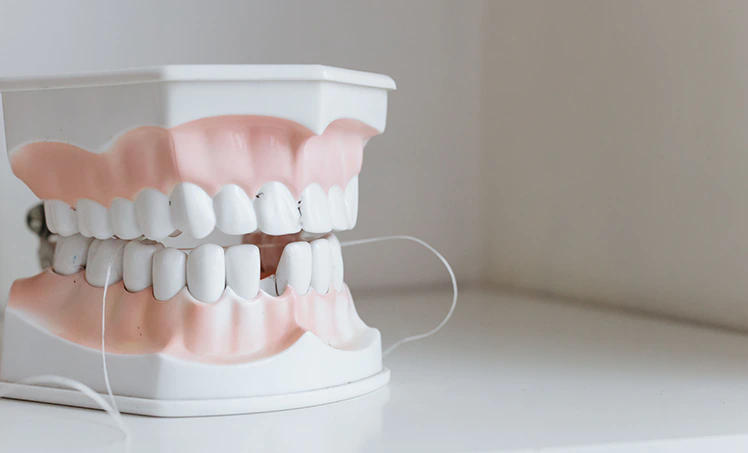
Hug the tooth in a C-shape and slide under the gumline. Flossing hurts when people saw down into the gum, so the curve is what saves you.
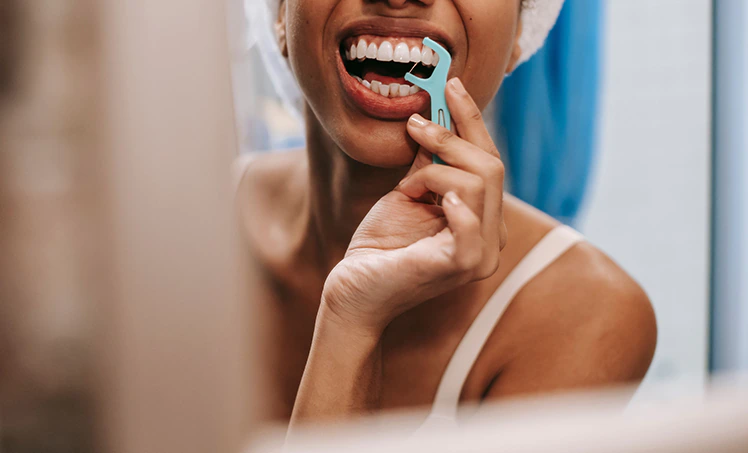
Wrap about 18 inches around your middle fingers and hold a short stretch between your thumbs. Slide it between two teeth with a gentle back-and-forth wiggle, no snapping.
Once it’s through, curve it into a C around one tooth and glide it under the gumline until you feel light resistance. Go up and down two or three times, then repeat the C on the neighboring tooth before you move on.
Use a clean section each time. And don’t skip the far side of your last molar, where more plaque hides than on any other surface in the mouth.
Bleeding means inflammation, and the fix is usually more flossing. Daily flossing typically stops it within seven to ten days.
I know that sounds backwards. Bleeding gums are your immune system reacting to plaque that’s been sitting there, and clearing that plaque every day lets the tissue calm down. If the bleeding continues past two weeks, come see someone.
The cleanest floss in the world does nothing if it stays in the drawer.
And no floss, coated or not, treats gum disease that has already formed pockets. That takes a professional cleaning and a look at the root causes, from mouth breathing to blood sugar.
Choose the safest floss you will actually use every night. If that’s a fluorinated one for now, I’d still rather you floss.
PTFE-coated floss is the only kind with evidence linking it to PFAS in the body, and that evidence is one study with a plausible mechanism. Newer Glide no longer uses PTFE, but older boxes and other brands might, so read the label. A PFAS-free floss like Cocofloss, silk, or bamboo sidesteps the question entirely. Floss the C-shape way, under the gumline, every night; that habit protects your health more than any ingredient list ever could.
How do I know if my floss has PFAS? Read the ingredient list for “PTFE” or “polytetrafluoroethylene,” and be suspicious of words like “glide,” “shred-resistant,” or “comfort” with no material listed. Formulas change, so check even a brand you trust. If a company won’t tell you what the coating is made of, that alone is a reason to pick a different floss.
Is unwaxed floss safer than waxed floss? The wax is rarely the issue. Plant waxes like candelilla and beeswax are fine, and they help floss slide without fraying. The ingredient worth avoiding is a PTFE coating, which gives that super-slick feel. Unwaxed floss is a good choice if you like it, but it shreds more on tight contacts.
Are floss picks bad for you? Floss picks are fine for reaching back teeth, especially for children and anyone with limited hand mobility. The catch is technique; a pick makes the C-shape hard, so it tends to snap down and skip under the gumline. Many picks also use PTFE-type floss, so check the packaging.
How often should you floss? Once a day, every day. Nighttime is best, because saliva flow drops while you sleep and plaque left between teeth has eight quiet hours to settle in. Consistency beats perfect technique. A slightly sloppy nightly floss does far more for your gums than an immaculate one twice a month.
Dr. Staci Whitman, DMD, FMCP, is a board-certified dentist and is certified in functional medicine. She is based in Portland, Oregon and is the author of SPIT (Crown, 2027).