Discover more from Dr. Staci on Substack.
Fix cavities, bad breath, receding gums, snoring, and hormones at the root. Weekly at-home tips from a board-certified dentist, because “brush, floss, and avoid sugar” were never the only answers. 🦷

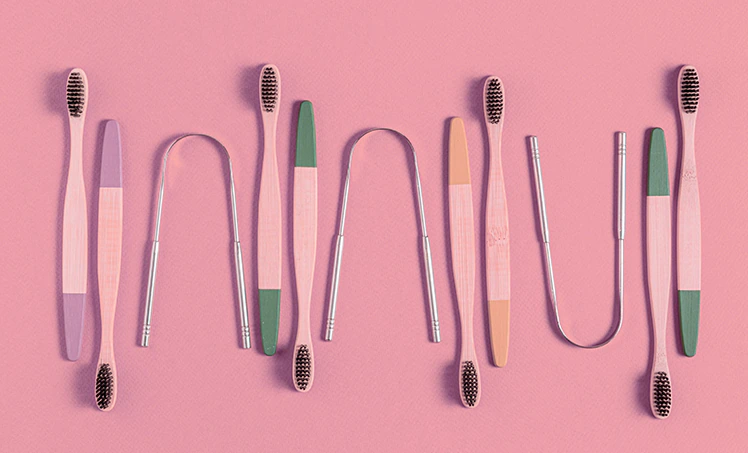

That pale coating is where most of your morning breath lives. Brushing barely moves it. A ten-dollar piece of metal does.
If I could add one habit to every adult’s morning, it would be scraping the tongue, and the tongue scraping benefits show up within days.
Yes. A scraper removes the coating where most bad breath is made, and in head-to-head testing it beat a toothbrush by a wide margin.
Around 80 to 90 percent of bad breath starts in the mouth, and the tongue coating is the biggest single source. Your tongue is covered in papillae, tiny bumps and crevices that trap dead cells, food debris, and the mucus that drips down from your sinuses overnight.
Anaerobic bacteria love that low-oxygen film. They break down proteins into volatile sulfur compounds: hydrogen sulfide, which smells like rotten eggs, and methyl mercaptan, which somehow smells worse.
A 2004 study from Pedrazzi and colleagues at the University of São Paulo compared a tongue scraper to a toothbrush for cleaning the tongue and measured sulfur compounds directly. The scraper cut volatile sulfur levels by about 75 percent. The toothbrush managed about 45.
A Cochrane review two years later landed in the same place, with more hedging: scrapers beat brushes for short-term breath improvement, and longer trials would be nice.
You can, and it helps, but a scraper does the job better. Bristles flick across the coating and spread some of it around, while a flat edge lifts it off in one pass.
That 45 versus 75 percent gap from São Paulo is the whole argument. Brushing your tongue is better than nothing, and a scraper is better than brushing.
For a lot of people it does. Patients tell me food tastes brighter after about a week of scraping, and a 2004 Belgian study backs that up: removing the coating improved taste sensitivity.
Taste buds buried under a layer of debris are taste buds working at half signal.
And no, gentle scraping doesn’t damage them. You’re pulling a film off the surface, and your taste buds sit tucked between the papillae. Pressing hard enough to hurt is the only way to get this wrong.
It removes the debris and the odor-making anaerobes while leaving the helpful nitrate-reducing bacteria in place. This is my favorite part.
The crypts of your tongue house bacteria that turn the nitrate in leafy greens and beets into nitrite, the first step toward nitric oxide. Nitric oxide relaxes blood vessels and supports healthy blood pressure.
Antiseptic mouthwash wipes those bacteria out. A 2013 trial out of Queen Mary University of London showed antiseptic rinsing raised blood pressure within a week.
Gentle scraping behaves very differently. A 2019 paper from Nathan Bryan’s collaborators at UTHealth Houston found that tongue cleaning shifts the makeup of the tongue community without wiping out its ability to reduce nitrate.
You clear out the dead debris and the anaerobes riding on it, and the deeper residents stay put. That is the difference between weeding a garden and paving it.
Do it first thing in the morning, before water or coffee. The coating builds overnight, and you’d rather get it out than swallow it.
Stick your tongue out and set the scraper as far back as you comfortably can. Pull forward with light pressure, rinse the scraper, and repeat three or four times before rinsing your mouth.
The pass should be firm enough to bring off a visible film and gentle enough that nothing stings. If you gag, breathe out slowly as you pull, and start a little further forward until your reflex calms down. It usually does within a week or two.
Either one. Copper has some antimicrobial activity of its own, and stainless lasts forever and goes in the dishwasher.
Both beat plastic, which flexes and skips right over the coating. Pick the one you’ll keep next to your toothbrush.
A thick white or yellow coating that comes back every day usually means your mouth is drying out overnight, most often from mouth breathing.
I ask every patient to stick their tongue out, and the reactions are half the fun. One dad stuck his out, saw my face, and said, “Oh no. Is it the white stuff? My wife says it’s the white stuff.” It was the white stuff, thick as frosting on the back third, and two questions later he admitted he wakes up every morning with his mouth hanging open.
Saliva is your built-in rinse. Without it, bacteria multiply fast, and the film piles up by sunrise.
A patchy white film that wipes off and leaves red tissue underneath is a different story. That can be thrush, a Candida overgrowth that’s common after antibiotics or in people using steroid inhalers.
Scraping helps with the coating either way, but the fix is upstream: nasal breathing, hydration, and treating the yeast if it’s there.
If your breath is still bad after two weeks of daily scraping, your tongue was never the main source.
Bleeding gums and periodontal pockets make their own sulfur gases, and tonsil stones smell exactly the same. Reflux can push odor up from below, and a sinus infection can send it down from above. A scraper can’t reach any of those.
Get your gums checked and look at the airway before you buy a stronger mouthwash.
Tongue scraping clears away the coating that makes sulfur gases, which is why it beats mouthwash for breath. Ten seconds each morning with a copper or steel scraper, back to front, before water. And watch what comes off; a persistent white coating usually points to mouth breathing or dryness, which is worth chasing.
How often should you scrape your tongue? Once a day, in the morning, is plenty for most people. That’s when the overnight coating is thickest. Some people like a second pass before bed, which is fine as long as the pressure stays light. More than twice a day buys you nothing extra and risks irritating the papillae.
Should you scrape your tongue before or after brushing? Most people scrape first, then brush, so the brush isn’t dragging tongue gunk around your teeth. Honestly, the order matters much less than doing it daily. Rinse the scraper under hot water after each pass, and let it dry in the open air between uses.
Can children use a tongue scraper? Yes, once they can tolerate it without gagging and understand “gentle.” Many families start around the age a child can spit reliably. For little ones, brushing the tongue softly with their toothbrush is a perfectly good start, and it’s a nice way to get them comfortable with the habit early.
Is it normal for a tongue scraper to make my tongue bleed? No. Bleeding means you’re pressing too hard or your scraper has a rough edge. Back off the pressure and check the edge for burrs. If your tongue bleeds or stays sore with light pressure, or you see a patch that doesn’t wipe away, have your dentist or doctor take a look.
Dr. Staci Whitman, DMD, FMCP, is a board-certified dentist and is certified in functional medicine. She is based in Portland, Oregon and is the author of SPIT (Crown, 2027).