Discover more from Dr. Staci on Substack.
Fix cavities, bad breath, receding gums, snoring, and hormones at the root. Weekly at-home tips from a board-certified dentist, because “brush, floss, and avoid sugar” were never the only answers. 🦷


Researchers at the University of Otago went looking in that child’s mouth and found a bacterium that fights back. That discovery is a big reason oral probiotics went from an obscure research project to a lozenge on every wellness shelf.
I get asked about them constantly. My position: a few specific strains have decent human trials behind them for bad breath and gum health, the benefits are modest, and the bacteria don’t move in permanently.
Think of an oral probiotic as a good houseguest rather than a new roommate. Whether it helps depends mostly on the house.
Yes, a little, for a few specific strains. The effects on breath and bleeding gums are real but small, and they fade within a few weeks of stopping.
Probiotic strains show up in saliva while you take them and mostly disappear afterward. Your mouth already has about 700 species competing for every surface, and a newcomer rarely wins a permanent seat.
That’s why the research on L. reuteri looks best as an add-on to gum treatment. The probiotic tilts the field while your hygienist removes the tartar and your habits change the conditions.
That’s how I’ve always used it. A mom I’ll call Jen came in with gums that bled if you looked at them sideways, and she said, “I’ve tried every rinse at Target.” We did a thorough cleaning, she started flossing nightly and letting an L. reuteri lozenge dissolve after brushing, and at her recheck the gums were pink and quiet. I can’t tell you how much of that was the lozenge, and that’s exactly the point: it was one helper on a team.
The short list: Streptococcus salivarius K12 for breath and throat, S. salivarius M18 for teeth, and Lactobacillus reuteri for gums.
K12 is the strain with the longest track record, and it’s the one from that New Zealand child. It makes two bacteriocins, salivaricin A2 and B, that suppress the bacteria behind sore throats and bad breath.
A 2006 trial found that K12 lozenges lowered volatile sulfur compounds in most people with halitosis. And a series of Italian studies starting around 2012 found children who took K12 daily had far fewer strep throat and tonsillitis episodes over the following year.
M18, its cousin, targets the teeth. It produces enzymes that break down plaque and neutralize acid, and a 2013 trial in schoolchildren found lower plaque scores in the M18 group after three months.
L. reuteri, usually the DSM 17938 and ATCC PTA 5289 pair sold as Prodentis, has the best gum data. Several randomized trials, including work from Leuven in Belgium, found less gingival bleeding and shallower pockets when patients took it alongside a professional cleaning.
L. paracasei and L. rhamnosus GG have smaller studies, including a Finnish daycare trial where children drinking milk with LGG had fewer cavities.
Everything else on the label, from L. acidophilus to Bifidobacterium, is mostly there for the gut and has little oral evidence.
Saliva flow, nasal breathing, and eating frequency decide which bacteria thrive in your mouth, because they control how much acid sits on your teeth and for how long.
If you scrape your tongue, floss nightly, and breathe through your nose at night, a probiotic has a fighting chance to help.
If your mouth is dry all night from mouth breathing, the acid-loving bugs will out-compete anything you take. You can’t out-supplement a desert.
This is the oral microbiome in a nutshell, and it’s why functional dentistry starts with the conditions in the mouth before reaching for the product.
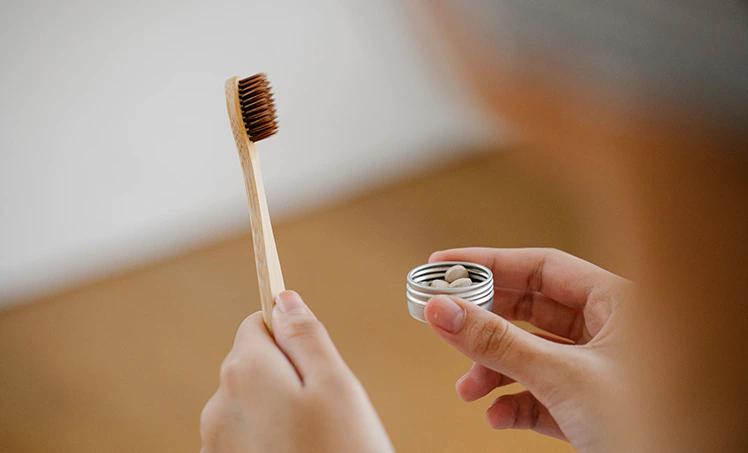
Let a lozenge or chewable dissolve slowly in your mouth after brushing at night. A swallowed capsule heads straight to the gut and skips your teeth and tongue entirely.
Nighttime is the sweet spot because your mouth has the least competition and the longest stretch without food. Let it dissolve without chewing it up.
Look for the strain names on the label, K12 or L. reuteri DSM 17938 for example. A vague “probiotic blend” tells you nothing about whether it’s been studied.
Give them at least a month of daily use before you judge. That’s how long most of the trials ran.
And remember they’re a rental. When you stop, the strains fade from your saliva within a few weeks, along with most of the benefit.
Your resident bacteria want lunch too.
Nitrate-rich vegetables like arugula and beets feed the nitrate-reducing bacteria that support nitric oxide and healthy blood pressure. Xylitol gum after meals starves Streptococcus mutans, and fiber-heavy meals scrub your teeth while they feed your microbes.
An oral probiotic on top of an alcohol mouthwash habit is money down the drain. The rinse kills the strain you paid for along with everything else.
A probiotic won’t treat a cavity, won’t reverse periodontal bone loss, and won’t stand in for floss. If you have persistent bleeding or breath that won’t budge, get the cause diagnosed first, and bring the lozenge in afterward as a helper.
The oral probiotics with real data are a short list, led by S. salivarius K12 for breath and L. reuteri for bleeding gums. Take them as lozenges after brushing at night, for at least a month, and expect a modest nudge. Fix the terrain first; a healthy mouth is the only one where a probiotic can stay.
Are oral probiotics safe for children? For healthy children, the strains in the research have a good safety record; the Italian K12 studies and the M18 trial were done in children. Choose a chewable or lozenge sized for their age, skip added sugar, and check with your child’s doctor first if they’re immunocompromised or have a serious medical condition.
Can you take oral probiotics and gut probiotics together? Yes. They’re doing different jobs in different neighborhoods. Take the gut probiotic with a meal as directed, and let the oral one dissolve after brushing at night. Many gut strains aren’t the ones with oral evidence anyway, so one product rarely covers both well.
Do oral probiotics have side effects? The trials reported few problems in healthy people. The bigger risk is to your wallet: a product with unnamed strains or tiny doses that does nothing. If you’re immunocompromised, talk to your doctor before starting any live bacteria.
Are the oral probiotics advertised all over social media legit? Judge them by the label. Look for named strains with human trials (K12, M18, L. reuteri DSM 17938 and ATCC PTA 5289) at amounts close to what the studies used. Promises of regrowing gums, reversing cavities, or ending dentist visits are a red flag. A probiotic is a nudge, and that’s all a good one promises.
Dr. Staci Whitman, DMD, FMCP, is a board-certified dentist and is certified in functional medicine. She is based in Portland, Oregon and is the author of SPIT (Crown, 2027).