Discover more from Dr. Staci on Substack.
Fix cavities, bad breath, receding gums, snoring, and hormones at the root. Weekly at-home tips from a board-certified dentist, because “brush, floss, and avoid sugar” were never the only answers. 🦷

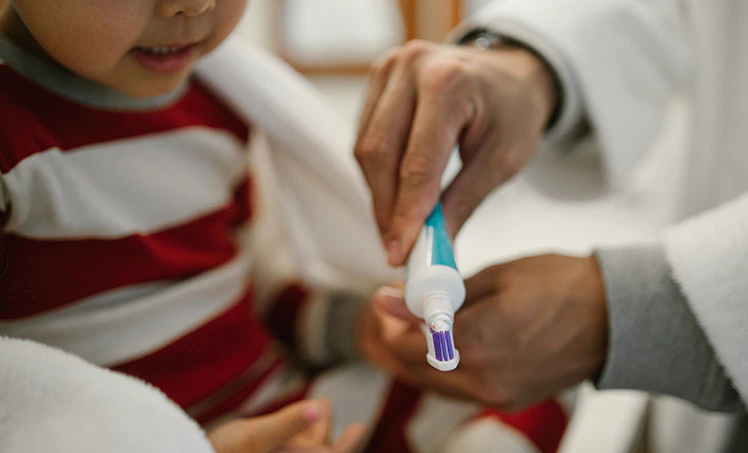

My answer to “what’s the best toothpaste for toddlers?” is short. Pick a paste with an ingredient that puts mineral back into enamel, skip the additives a 2-year-old has no business swallowing, and use an amount the size of a grain of rice.
Toddler toothpaste should have either hydroxyapatite or fluoride. Those are the two ingredients with real evidence for putting mineral back into enamel.
Here’s why that matters. Enamel loses mineral every time the mouth turns acidic, which is after every meal and every sip of milk, and it gains mineral back from saliva in between. It’s a constant tug of war. A good toothpaste tips it toward gaining.
Yes, and that’s exactly why it’s my first pick for toddlers: they swallow toothpaste, and hydroxyapatite is safe to swallow.
Hydroxyapatite is the same calcium phosphate mineral your enamel is made of. In nano form, it fills the microscopic pits that acid leaves behind and binds to the tooth surface, a bit like spackle made from the wall’s own material.
The idea has a long track record. Japan has used hydroxyapatite in toothpaste since the 1980s. Randomized trials, including one led by Bennett Amaechi at UT Health San Antonio in 2019, have found that hydroxyapatite toothpaste keeps up with fluoride toothpaste at remineralizing early lesions in children.
And for toddlers in particular, it’s a food-grade mineral. When your 2-year-old eats the toothpaste off the brush (and they will), it’s a nonevent. That’s why hydroxyapatite is what parents ask me about most. #7 goes deep on it.
Yes, used carefully. I’m not anti-fluoride. Topical fluoride works, and for a toddler with active cavities and a high-risk mouth, a fluoride toothpaste has decades of data behind it. It’s still considered the gold standard, and it’s your call as the parent.
Fluoride hardens the outer layer of enamel into a more acid-resistant form. Its benefit is topical, on the tooth surface.
The catch for toddlers is swallowing. Fluoride that gets into a toddler’s stomach travels to the adult teeth still developing in the jaw and can cause fluorosis, which shows up as white streaking on the adult front teeth. That’s exactly why the rice-grain amount exists.
If you choose fluoride, measure carefully and it can be a perfectly fine choice. If your toddler eats toothpaste like frosting, a fluoride-free toothpaste for toddlers built on hydroxyapatite removes that worry entirely. #6 covers my full take on fluoride for little ones.
Skip sodium lauryl sulfate, artificial dyes, titanium dioxide, strong mint, and “training” toothpaste with no active ingredient.
Sodium lauryl sulfate (SLS). It’s the foaming detergent in most adult toothpaste, and it irritates soft tissue. Children who get canker sores often stop getting them once SLS leaves the house. (#41 has more on canker sore triggers.)
I once had a mom bring in her 5-year-old for his third canker sore in a month. “He keeps saying the toothpaste is spicy,” she told me, “and I thought he was being dramatic.” He wasn’t. They switched to an SLS-free paste, and at the next visit she reported zero sores and one very smug little boy.
Artificial dyes. The Red 40 and Blue 1 kind do nothing for teeth.
Titanium dioxide. It’s a whitening pigment that the European Union pulled from its food supply in 2022 over unresolved safety questions. I see no reason for it to be in something a toddler swallows every night.
Strong mint. Young children find it burning, and a burning toothpaste turns into a brushing battle. Mild fruit or vanilla flavors get more cooperation, which is the outcome you actually care about.
“Training” toothpaste with no active ingredient. It’s flavored gel. Cute tube, no mineral.
These are the ones I reach for:
If your family chooses fluoride, pick a brand without SLS or dyes and hold the line on the rice grain.
Every one of these is a mineral delivery vehicle. The brush technique behind it is what gets the mineral where it needs to go.
Toothpaste is about 10 percent of the job.
The other 90 percent is whether the brush reaches the gumline and back molars, how many times a day the mouth is bathed in milk or snacks, and whether your child breathes through the nose at night.
I’ve seen children on the best toothpaste in the world get cavities from a sippy cup. I’ve seen children on plain grocery-store toothpaste stay cavity-free for years because they eat three meals and drink water. The tube helps. The habits decide.
The best toothpaste for toddlers has hydroxyapatite or fluoride to rebuild enamel, a mild flavor they’ll let you use, and no SLS or dyes. I reach for hydroxyapatite first because a toddler can swallow it without concern, and Boka and RiseWell make versions I like. Theodent’s children’s paste is the chocolate option, and NOBS tablets come out once your child can chew and spit. Use a rice-grain smear, aim for the gumline, and remember that the toothpaste is the smallest part of the equation.
What toothpaste is safe if my toddler swallows it? Hydroxyapatite toothpaste is the one I trust here, because it’s a food-grade form of the same mineral your enamel is made of. Swallowing a rice-grain smear is a nonevent. Fluoride toothpaste can be used too, but only in that rice-grain amount, since swallowed fluoride can lead to fluorosis on the adult teeth.
Can my toddler just use my adult toothpaste? In a pinch, a rice-grain smear won’t hurt. But most adult toothpastes have SLS and a strong mint that toddlers find burning, which makes brushing harder for both of you. A mild children’s toothpaste with hydroxyapatite, or fluoride if that’s your choice, usually gets much better cooperation at the sink.
When should my toddler start using a pea-sized amount? Around age 3. Stick to a rice-grain smear before that, then move to a pea-sized amount from about 3 to 6. If you use fluoride toothpaste, the bigger amount makes the most sense once your child can reliably spit, which many 3-year-olds are still practicing.
Is xylitol in toddler toothpaste a good thing? In toothpaste, yes. Xylitol is a sugar alcohol that cavity-causing bacteria can’t use for fuel, so it’s a friendly sweetener for teeth. One warning: xylitol is toxic to dogs, so store the tube somewhere the family dog can’t get to it.
Dr. Staci Whitman, DMD, FMCP, is a board-certified dentist and is certified in functional medicine. She is based in Portland, Oregon and is the author of SPIT (Crown, 2027).