Discover more from Dr. Staci on Substack.
Fix cavities, bad breath, receding gums, snoring, and hormones at the root. Weekly at-home tips from a board-certified dentist, because “brush, floss, and avoid sugar” were never the only answers. 🦷

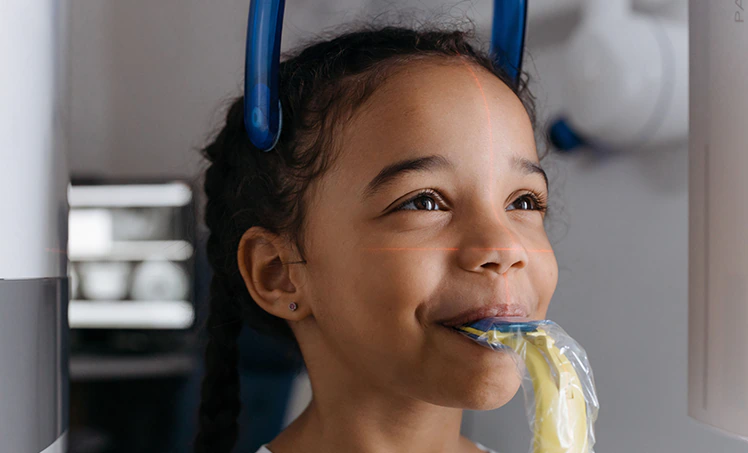

Dental x-rays for children are low dose. I still think every image should have a reason a parent can hear and agree with.
My position: x-rays are the only way I can see between the back teeth, which is where children get most of their cavities, and the schedule should follow your child’s cavity risk. The insurance calendar doesn’t get a vote.
Yes, the dose is very small. A set of digital bitewings delivers on the order of a day or two of the background radiation your child already absorbs from the ground and sky.
Bitewings are the two to four images that show the back teeth biting together. A panoramic film, the one where the machine circles the head, is a few days’ worth.
Modern sensors need a fraction of the exposure old film did. And a rectangular collimator on the machine narrows the beam to the size of the sensor, so scatter drops further. Ask whether your dentist uses one; it’s a great nerdy question and a good office will love it.
Small still isn’t zero, though. Radiation effects add up over a lifetime, and a child has more lifetime ahead than an adult. The thyroid sits right below the jaw and is one of the more radiation-sensitive tissues in a growing body.
A bitewing is safe, and it should still have to earn its spot every single time.
That’s a different posture than “it’s time for your films,” and it’s the one I want for your child.
Because in early 2024 the American Dental Association published new guidance saying lead aprons and thyroid collars are no longer needed for routine dental imaging.
The reasoning: digital sensors and collimated beams have shrunk scatter to the point where shielding adds nothing measurable. A badly placed apron or collar can also block part of the image, which means a retake and a second dose.
The physics behind that is sound. I’d rather have a properly collimated machine than a heavy apron over a wide beam.
That said, a thyroid collar on a child costs nothing if it’s placed so it stays out of the beam. I think it’s completely reasonable to ask for one.
Risk decides, and the ADA and FDA guidelines are built that way. Every six to twelve months for a cavity-prone child, every twelve to twenty-four months for a low-risk one.
A child with active decay, a snacking or juice habit, mouth breathing or a family history of cavities is high risk. Bitewings every six to twelve months let me catch a lesion between two molars while it’s still small enough to remineralize.
A child with no cavities, a whole-food diet, nasal breathing and clean checkups is low risk, and every twelve to twenty-four months is plenty.
If a dentist wants images every six months on a low-risk child, ask why. A specific concern about a specific tooth is a good reason. “Insurance covers it” is not one.
The first bitewings usually make sense once the back baby molars have grown into contact with each other, often around age four to six. Before that, I can see between the teeth with my own eyes.
A panoramic film comes into the picture around six or seven, to check that the adult teeth are all present and pointed the right direction. It’s basically a census of the teeth that haven’t shown up yet.
Say not yet when there’s no clinical reason on the table: a low-risk child with no visible trouble and recent images.
Say not yet when a child can’t hold still or tolerate the sensor. A blurry retake is a wasted dose.
And say not yet if the office can’t explain what they’re looking for.
Then say yes when a tooth hurts, when your child’s cavity risk has climbed, and when it’s been long enough that I’m guessing about the spaces I can’t see.
Skipping every x-ray leaves between-teeth cavities to grow unseen.
Decay between two molars is invisible to a mirror until it has eaten through to the chewing surface or started to hurt. By then the remineralization window has closed and we’re talking about a filling. Sometimes it’s a tooth that has to come out and take its space with it.
A mom once told me her five-year-old had “perfect teeth, every dentist says so,” and with a mirror I agreed with every one of them. The bitewings showed two little shadows between the back molars, each about the size of a sesame seed, right where the teeth touch. Caught that small, they got diet changes and remineralizing care instead of a drill, and they hadn’t budged at the next set of images.
Saying no forever feels protective. In this one spot, it can backfire.
Dental x-rays for children are very low dose, and I still want a reason for each one. Match the interval to risk: six to twelve months for a cavity-prone mouth, twelve to twenty-four for a low-risk one. Ask for rectangular collimation, ask for a thyroid collar if you want one, and ask what the image is for. A good dentist will be glad you did.
Can I refuse dental x-rays for my child? Yes, it’s your call, and a good office will document it and keep talking with you. Just make it an informed no. Ask what they’re looking for and what happens if a cavity between the molars goes unseen for another year. Sometimes “not yet” is perfect, and sometimes the risk has changed enough that yes is the safer answer.
My dentist wants x-rays on my 4 year old. Is that necessary? It depends on whether the back baby molars are touching. If they are, bitewings are the only way to see between them, and four is a common age to start. If they aren’t touching yet, or your child is low risk with recent images, it’s fair to ask whether waiting makes sense.
How much radiation is a dental x-ray? A set of digital bitewings is on the order of a day or two of normal background radiation, the kind everyone absorbs from the ground and sky. A panoramic film is a few days’ worth. Rectangular collimation trims exposure further by narrowing the beam to the size of the sensor.
Do children need dental x-rays every year? Only if their risk says so. High-risk children benefit from bitewings every six to twelve months, while low-risk children can go twelve to twenty-four months between sets. The interval should match your child’s mouth, diet and history, and it’s fine to ask your dentist how they decided.
Dr. Staci Whitman, DMD, FMCP, is a board-certified dentist and is certified in functional medicine. She is based in Portland, Oregon and is the author of SPIT (Crown, 2027).