Discover more from Dr. Staci on Substack.
Fix cavities, bad breath, receding gums, snoring, and hormones at the root. Weekly at-home tips from a board-certified dentist, because “brush, floss, and avoid sugar” were never the only answers. 🦷

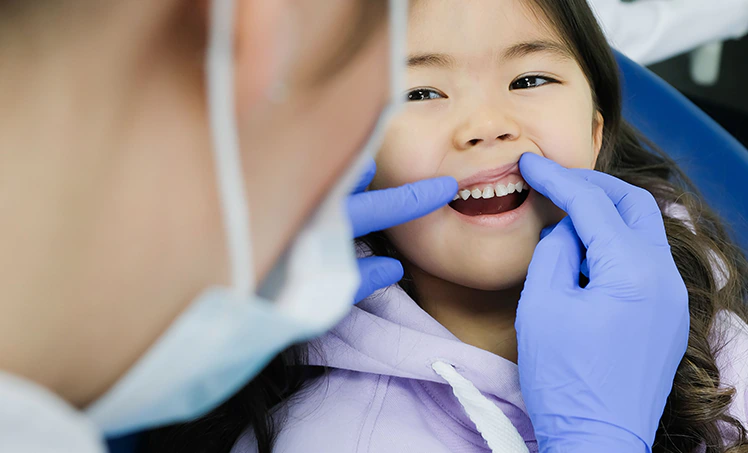

Mouth breathing in children is one of the most under-recognized causes of cavities and crowded teeth I see, and it gets waved off as a quirk. My take: how a child breathes shapes the mouth I’m looking at. If I only fix the teeth, I’ll be fixing them again next year.
Yes, if it happens most nights, it’s worth taking seriously. An open mouth at night usually means the nose isn’t doing its job, and that dries out saliva, changes how the jaw grows and breaks up sleep. A child with a stuffy nose from a cold gets a pass. A child who sleeps open-mouthed every night of the year deserves a closer look.
It can, and it’s one of the sneakiest routes to cavities in a well-brushed mouth.
Saliva is the mouth’s defense system. It buffers acid after every meal, carries calcium and phosphate back into enamel, and holds proteins that keep cavity bugs in check. A child who breathes through the mouth all night dries that saliva out for hours at a stretch.
The pH drops and the acid-loving bacteria throw a party. The front teeth and gums take the hit first, because that’s where the air moves.
I see a very specific pattern in these children: red, swollen gums along the upper front teeth and white chalky spots near the gumline, in a mouth that gets brushed.
“She brushes twice a day. I stand there and watch her,” one dad told me, almost pleading, and I believed him. His seven-year-old had puffy gums along her upper front teeth, red as a strawberry, with three chalky spots tucked at the gumline and lips cracked at the corners. Once an ENT and an allergist got her nose open and she started sleeping with her lips closed, those gums calmed down within a few months.
The brushing is fine. The mouth is dry.
You can’t out-brush a dry mouth.
Yes, and this is the part that keeps me up at night.
When the lips are closed and the nose does the work, the tongue rests up against the palate and acts as a natural expander, widening the upper jaw a little more every day. Free orthodontics, running 24 hours a day.
When the mouth hangs open, the tongue drops to the floor of the mouth and the cheeks press inward with nothing pushing back. The palate narrows and rises into a high vault. The lower jaw swings down and back instead of growing forward.
Over years that produces what people call the “mouth breathing face”: a long, narrow face, a small chin, crowded teeth and a gummy smile.
Egil Harvold’s primate studies at UCSF in the early 1980s showed this directly. Block the nose in a growing animal and the face changes shape.
The sleep piece matters as much as the teeth. Mouth breathers often snore, toss, sweat and wake unrefreshed. And a tired child rarely looks tired; a tired child looks wired.
A 2012 study of more than 11,000 children out of Albert Einstein College of Medicine, published in Pediatrics, found that children with early sleep-disordered breathing symptoms were roughly 40 to 100 percent more likely to have behavioral problems by age seven.
Some of those children are getting an ADHD label when what they need first is an airway evaluation. I say that gently, because behavior has many causes. But breathing belongs on the checklist.
Usually because the nose is blocked, or it was blocked long enough for the habit to stick. A few common culprits:
That last one is a loop, and loops are why this problem rarely fixes itself.
Start with why the nose is closed. You cannot train a child to breathe through a blocked nose, any more than you can coach someone to sprint with a sock in their mouth.
I want an ENT and an airway-aware dentist looking at the same child, plus an allergy workup if there’s any hint of one.
Then clean up the bedroom: a HEPA filter, hot-washed bedding, dust mite covers, and the dog off the bed for a month (the dog will survive). A saline rinse or Xlear nasal spray (saline plus xylitol) before bed helps many children breathe through the night.
Once the nose is open, myofunctional therapy retrains the tongue to rest on the palate and the lips to close at rest.
If the palate is already narrow, an expander widens the nasal floor and gives the tongue room, which often makes nasal breathing possible in the first place.
Saline and xylitol reduce swelling and thin mucus. That’s their whole job. They won’t shrink tonsils or adenoids that are blocking the airway, and they won’t widen a narrow palate.
And mouth taping, which I like for adults, is off the table for children unless a professional has confirmed the nose is open and the child can breathe through it comfortably all night.
Mouth breathing in children dries out the saliva that protects teeth, narrows the growing palate and fragments sleep in ways that show up as behavior. Find out why the nose is blocked and fix that with the right people, then retrain the tongue and lips. Closed lips at rest is a growth strategy for a child.
Is mouth breathing normal for a toddler? Occasional mouth breathing during a cold is normal. Habitual mouth breathing, awake or asleep, is common, and it still deserves a look. If your toddler’s lips are usually apart while watching a show or sleeping, it’s worth asking your pediatrician, an ENT or an airway-focused dentist to check the nose, tonsils and adenoids.
Can mouth breathing look like ADHD? It can overlap. Poor sleep from blocked breathing often shows up in children as hyperactivity and trouble focusing, and the 2012 Pediatrics study linked early sleep-disordered breathing to more behavioral problems by age seven. Plenty of those diagnoses are right. An airway check still belongs in the workup.
Will my child grow out of mouth breathing? Sometimes the cause shrinks on its own, since tonsils and adenoids peak between three and seven. But the habit and the jaw changes can stick around after the blockage is gone. That’s why myofunctional therapy matters: it teaches the tongue and lips a new resting position instead of hoping they find it.
What kind of doctor treats mouth breathing in children? Usually a team. An ENT looks at tonsils, adenoids and the nasal passages, an allergist checks for triggers, an airway-focused or functional dentist looks at the palate and jaw growth, and a myofunctional therapist retrains the tongue and lips. Your pediatrician is a good place to start the referrals.
Dr. Staci Whitman, DMD, FMCP, is a board-certified dentist and is certified in functional medicine. She is based in Portland, Oregon and is the author of SPIT (Crown, 2027).